TTC.kz Virtual Data Center, KZT 19,200.00/mo. on Linux/Windows Cloud
Virtual Data Center has been added on Sep 7, 2026
10 Kunaev Street
Astana , 010000 KZ
☎ Phone 191[Contact Center]
☎ Phone +7(7172)611-456[Central Office]
☎ Phone +7(771)010-01-91[WhatsApp]
📧 org@t...| 💪 CPU/Cores : | 4 Cores |
|---|---|
| 🔋 RAM : | 4000 MB |
| 🔌 Hosted domains : | 1 |
| 🆓 free domains : | 0 |
| 📌 Dedicated IPs : | 0 |
| 💳 Payment Methods : | Wire Transfer |
| 🔧 Category : | Backup |
| ✍️ Support Options : | EmailPhone / Toll-FreeOnline: Skype, Whatsapp ...Available 24/7 |
| 🌏 Server Locations : | Kazakhstan |
| ⚑ Targeting : | KZ |
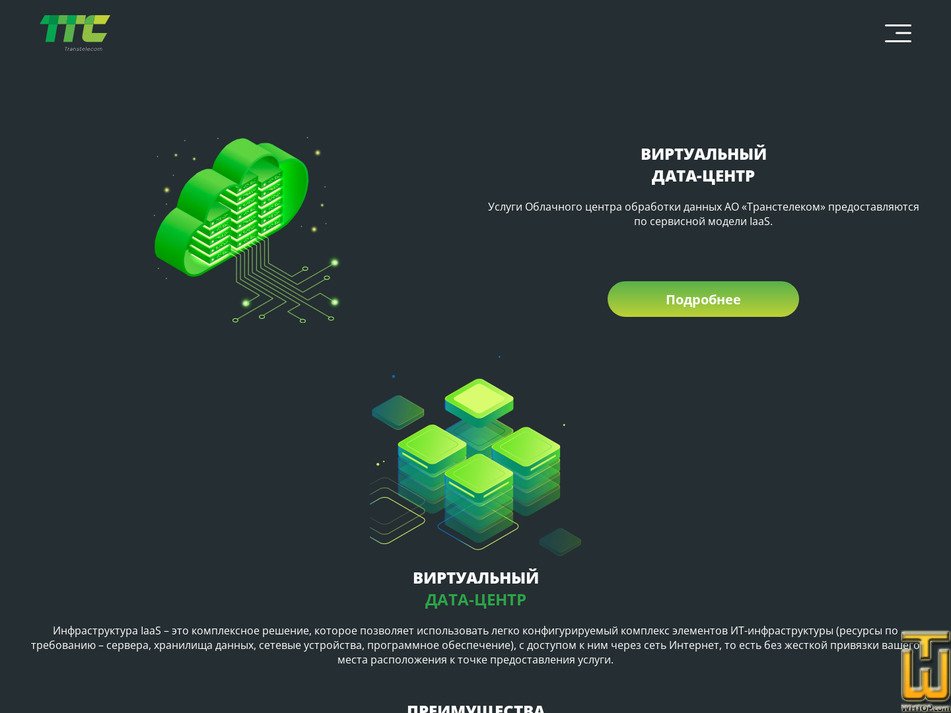
See also initial Virtual Data Center plan location on their website!
*📜 Plan description
Virtual Data Center uses a configurable IaaS model rather than fixed named tiers. The lowest practical SSD configuration produced by the calculator contains 4 CPU cores, 4 GB of RAM, one virtual machine, and 20 GB of SSD capacity. CPU costs 8,000 KZT per month, RAM costs 8,400 KZT per month, the SSD costs 2,800 KZT per month, and the virtual-machine counter adds no separate charge, giving a base monthly price of 19,200 KZT before an optional public-IP block. The calculator also offers archive and ordinary 7K/10K hard-disk capacity, with the first 20 GB step priced at 693 KZT and 690 KZT per month respectively. Optional IPv4 blocks range from 4 to 256 addresses; the displayed monthly prices are 3,500 KZT for 4, 6,121 KZT for 8, 9,562 KZT for 16, 19,126 KZT for 32, 31,108 KZT for 64, 44,361 KZT for 128, and 54,795 KZT for 256 addresses.
The service provides on-demand servers, storage, network devices, and software through the Internet without tying the customer to a particular office location. It can move an existing IT environment into the cloud, absorb seasonal or peak-load growth, host websites and mobile or web applications, accelerate a startup deployment, provide a reserve site, or supply an isolated development and testing environment. The design removes the capital cost of buying equivalent equipment and can reduce the expense of maintaining a private server room. Geographically distributed clustering, backup capability, fault-tolerant cloud architecture, and hardware from established infrastructure vendors are part of the operating model. TTC identifies its data-center facilities as Tier 3 class. Resource sliders allow CPU, memory, SSD, archive disk, ordinary disk, public-address blocks, and virtual-machine quantities to be adjusted independently, so larger environments are assembled from the same measured components rather than purchased as a single rigid bundle.
The service provides on-demand servers, storage, network devices, and software through the Internet without tying the customer to a particular office location. It can move an existing IT environment into the cloud, absorb seasonal or peak-load growth, host websites and mobile or web applications, accelerate a startup deployment, provide a reserve site, or supply an isolated development and testing environment. The design removes the capital cost of buying equivalent equipment and can reduce the expense of maintaining a private server room. Geographically distributed clustering, backup capability, fault-tolerant cloud architecture, and hardware from established infrastructure vendors are part of the operating model. TTC identifies its data-center facilities as Tier 3 class. Resource sliders allow CPU, memory, SSD, archive disk, ordinary disk, public-address blocks, and virtual-machine quantities to be adjusted independently, so larger environments are assembled from the same measured components rather than purchased as a single rigid bundle.
📄 Editorial Review
TTC / Transtelecom JSC is one of Kazakhstan’s major telecommunications and IT infrastructure operators, with a history dating to 1999, when a communications division of Kazakhstan Temir Zholy was separated into the independent Transtelecom company. The business subsequently expanded far beyond railway communications into national telecommunications, cloud computing, data-center services, systems integration and enterprise digital infrastructure. By the end of 2024, TTC employed 2,764 people and operated more than 24,000 km of fiber-optic backbone, placing it in a very different category from a conventional shared-hosting provider.Its ownership combines private and state-connected interests. At the end of 2024, Unit Telecom LLP held 75% minus one share, while National Company Kazakhstan Temir Zholy JSC held 25% plus one share. TTC therefore remains closely connected to the infrastructure environment from which the company originally developed while operating a broad commercial telecommunications and IT portfolio.
For hosting customers, the most relevant services are Public Cloud, Virtual Servers, Virtual Data Center/IaaS, Simplehost, S3-compatible Object Storage, Managed Kubernetes, App Platform, load balancing, virtual networking, backup, snapshots and Co-location. The overall environment is closer to a regional cloud and infrastructure platform than to a traditional host built around a few fixed Linux hosting plans.
Virtual Data Center (VDC) provides isolated infrastructure resources covering virtual machines, storage and networking. Computing resources can be adjusted without purchasing physical hardware, making the platform suitable for websites, corporate applications, databases, development environments, backup systems, seasonal projects and enterprise workloads. The service can also support geographically distributed and disaster-recovery architectures.
The newer Public Cloud provides self-service infrastructure where virtual machines are configured by region, operating system, processor, memory, storage and network requirements. Machine profiles cover several workload classes. Cloud Server configurations work well for lightweight websites, applications, blogs, test environments, caching and smaller databases. Compute Server configurations prioritize processor-intensive applications, while Memory Server is intended for workloads with larger RAM requirements. General Server balances processor and memory resources for production systems, higher-traffic websites, e-commerce platforms and similar business applications.
Virtual machines support password or SSH-key authentication, private and public IP connectivity and flexible resource management. Customers can create private networks and subnets, configure virtual routers and NAT, use security groups, attach floating IP addresses and deploy load balancers. Public and private interfaces can be added or removed as requirements change.
Virtual disks can be attached independently from the server lifecycle and increased when additional capacity becomes necessary. Snapshots provide convenient recovery points and can also be used to create new virtual machines. This gives administrators considerably more flexibility than a fixed VPS where compute and storage remain permanently tied to one instance.
Simplehost is the service closest to conventional web hosting. It provides a managed environment for PHP applications where customers select PHP and database versions and administer website files and databases without maintaining an entire virtual server. A built-in file manager and phpMyAdmin cover normal website administration, while CPU and RAM allocations can be scaled when the project grows. Each deployment can initially use an app.ttc.kz hostname before a customer domain is attached.
The App Platform provides a more developer-oriented PaaS environment. Applications can be deployed directly from source-code repositories without maintaining the operating system and underlying server infrastructure. Runtime detection covers environments such as Node.js and Ruby, while custom build commands, run commands, environment variables and encrypted values provide additional deployment flexibility. Repository updates can trigger automatic deployments, and applications can be scaled vertically or horizontally. Logs and performance statistics are integrated into the environment.
Object Storage adds S3-compatible storage for files, archives, application assets, backups and large datasets. Buckets can be managed through the cloud interface or through the S3 API. Private access is the default, bucket policies provide more detailed permission management, and SSE-S3 encryption is supported. This makes the storage suitable both for ordinary file repositories and for applications already designed around S3-compatible APIs.
Managed Kubernetes extends the platform to containerized applications. TTC manages the Kubernetes control-plane infrastructure while customers configure node pools, machine resources and storage. Standard kubeconfig credentials allow management through normal Kubernetes tools. Monitoring and Grafana integration are available, together with automatic node-pool scaling for workloads that need to respond dynamically to changing demand.
TTC also provides Co-location for customers that prefer to retain ownership of their physical servers. Equipment can be installed inside TTC data-center facilities with redundant network connectivity, protected power, cooling, environmental controls, video surveillance and fire-protection systems. Technical maintenance of customer equipment can also be delegated to TTC personnel when required.
The wider portfolio includes Internet connectivity, IP VPN, dedicated channels, international transit, cybersecurity, Service Desk/ITSM and systems integration. This is particularly useful for corporate customers because cloud infrastructure, colocation, private networking and telecommunications can be combined within the same provider.
The website is available in Russian, Kazakh and English, while the Public Cloud environment also accommodates these languages. Cloud services are priced in Kazakhstani tenge (KZT/₸).
📉 Similar hosting plans from other companies in the same category & country location ≡
- 💡 Plan: NVIDIA TESLA H100 (96 GB)
- 🔧 Category: Cloud
- 💻 OS Type: Linux/Windows
- 💰 Price: UZS 57.450.000/mo.
- 💿 Disk Space: 1000 GB
- 📶 Traffic bandwidth: unmetered
- 💲 Setup Fee: free
- 📅 Added:
- 🌏 Server in: