Tencent Standard BMS4, CNY 8,880.48/mo. on Linux/Windows Dedicated
Standard BMS4 has been added on Jul 30, 2026, Aggregate Rating (8 out of 10 from 1 reviews)

No. 33 Haitian 2nd Road, Nanshan District
Shenzhen , GUANGDONG 518054 CN
☎ Phone 0755-83765566
📧 dns@t...| 💪 CPU/Cores : | Intel Xeon Skylake, 80 cores, 2.4 GHz |
|---|---|
| 🔋 RAM : | 384000 MB |
| 🔌 Hosted domains : | unlimited |
| 🆓 free domains : | 0 |
| 📌 Dedicated IPs : | 0 |
| 💳 Payment Methods : | Credit / Debit / Prepaid CardsWire Transfer |
| 🔨 Control Panel : | [In-house] |
| 🔧 Category : | DDoS Protection |
| ✍️ Support Options : | EmailHelp DeskPhone / Toll-FreeLive ChatAvailable 24/7 |
| 🌏 Server Locations : | China |
| ⚑ Targeting : | CN US |
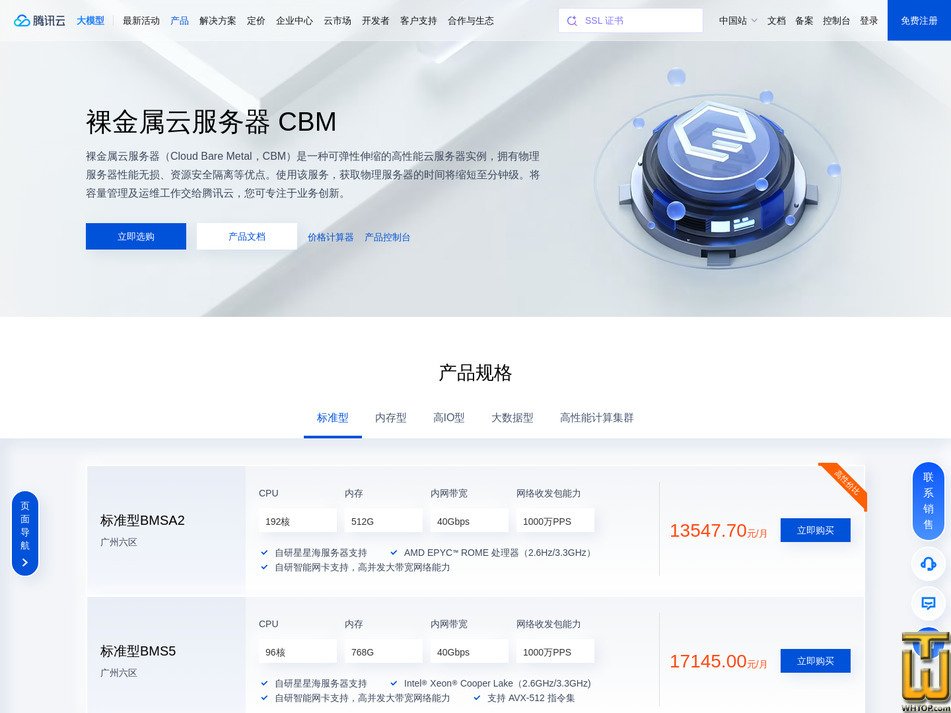
See also initial Standard BMS4 plan location on their website!
*📜 Plan description
Standard BMS4 is located in Guangzhou Zone 6. 25Gbps internal bandwidth; 10 million packets per second; ten 480GB SATA SSD local data disks configured as RAID50; discounted monthly price, with a 12686.4 CNY monthly list price.
Cloud Bare Metal combines the elasticity of cloud instances with dedicated physical-server performance. The server has no virtualization overhead or resource contention, and capacity can be delivered in minutes rather than through a traditional hardware procurement cycle. Operating-system deployment, storage partitioning, internal and external networking, monitoring and security are automated. Linux and Windows images are supported through the same image ecosystem used by cloud virtual machines. The service integrates with VPC, cloud disks, managed databases and other Tencent Cloud services while keeping compute resources physically isolated. High internal bandwidth, high packet-processing rates and large memory configurations suit big data, virtualization, games, high-performance computing and databases. Administrators receive dedicated hardware characteristics with cloud-style lifecycle management, monitoring, API access and elastic capacity planning.
Cloud Bare Metal combines the elasticity of cloud instances with dedicated physical-server performance. The server has no virtualization overhead or resource contention, and capacity can be delivered in minutes rather than through a traditional hardware procurement cycle. Operating-system deployment, storage partitioning, internal and external networking, monitoring and security are automated. Linux and Windows images are supported through the same image ecosystem used by cloud virtual machines. The service integrates with VPC, cloud disks, managed databases and other Tencent Cloud services while keeping compute resources physically isolated. High internal bandwidth, high packet-processing rates and large memory configurations suit big data, virtualization, games, high-performance computing and databases. Administrators receive dedicated hardware characteristics with cloud-style lifecycle management, monitoring, API access and elastic capacity planning.
📄 Editorial Review
Tencent is one of China’s largest internet and technology groups. The company was founded in 1998 in Shenzhen by Ma Huateng, Zhang Zhidong, Xu Chenye, Chen Yidan and Zeng Liqing. Ma Huateng, also known as Pony Ma, remains Chairman and Chief Executive Officer. Tencent employed 115,849 people at the end of 2025 and operates across consumer internet services, gaming, financial technology, digital media, artificial intelligence and enterprise infrastructure.Tencent Cloud was launched in 2013 and functions as a hyperscale cloud platform rather than a conventional web hosting company. Its range is considerably broader than ordinary shared hosting, covering virtual servers, dedicated infrastructure, cloud storage, managed databases, Kubernetes, networking, CDN, security, artificial intelligence and enterprise cloud systems.
Traditional shared hosting and reseller hosting are not central to the platform. The closest alternative for website owners is Tencent Cloud Lighthouse, a simplified VPS service that combines processing power, SSD storage, public bandwidth and monthly traffic in one prepaid package.
Lighthouse works particularly well for small business websites, WordPress projects, blogs, forums, ecommerce stores, development environments, personal cloud systems and lightweight business applications. Linux and Windows Server options are available, together with prepared application images for WordPress, WooCommerce, Docker, LAMP, Node.js, aaPanel, n8n, Dify and other popular tools.
The simplified Lighthouse interface makes deployment easier than a conventional public-cloud environment. Applications can be installed from prepared images, server snapshots can be created for recovery purposes, firewall rules are controlled from the console, and domains or SSL certificates can be connected to deployed applications.
Lighthouse also includes basic monitoring, Cloud Access Management integration, Anti-DDoS Basic and entry-level workload protection. The service remains self-managed, so customers are responsible for operating-system maintenance, application updates, backups, server security and troubleshooting.
Cloud Virtual Machine, commonly known as CVM, is Tencent Cloud’s main elastic server platform. It supports TencentOS Server, OpenCloudOS, Windows Server, Ubuntu, Debian, AlmaLinux, Rocky Linux, Red Hat Enterprise Linux, CentOS Stream, FreeBSD and Fedora.
CVM instances can be configured with different processors, memory capacities, system disks, data disks, public bandwidth allocations and private networking options. The available families include general-purpose, compute-optimized, memory-optimized, high-I/O, GPU and high-performance configurations.
The service supports public images, custom images, shared images, snapshots, security groups, elastic IP addresses, load balancing and automatic scaling. Servers can be deployed and managed through the cloud console, APIs, command-line tools, software development kits or Terraform.
CVM is suitable for SaaS platforms, ecommerce systems, gaming backends, application servers, high-traffic websites, databases and distributed enterprise workloads. It is significantly more flexible than Lighthouse, although it also requires greater knowledge of cloud networking, security policies, storage and usage-based billing.
Cloud GPU Service supplies GPU-accelerated virtual machines for artificial intelligence, model training, inference, rendering, scientific computing and video processing. Driver, CUDA and cuDNN installation can be automated, reducing the initial configuration work normally required for GPU servers.
Tencent Cloud also provides two important physical-server options. CVM Dedicated Host reserves an entire physical host for one customer while allowing multiple customized CVM instances to operate on that hardware. CPU, memory, disk and network resources remain isolated from other cloud tenants.
Cloud Bare Metal provides physical servers with cloud-style provisioning, networking and billing. These systems can be integrated with Virtual Private Cloud, cloud storage, Kubernetes and other Tencent services. They are suitable for large databases, game servers, private-cloud virtualization, big-data platforms, high-performance computing and GPU workloads.
Some bare-metal configurations reach 256 processor cores, high-capacity local storage and network connectivity of up to 100 Gbit. This gives demanding applications access to physical-server performance without losing the automation and network integration of a public-cloud platform.
The distributed-cloud portfolio includes Cloud Dedicated Zone, Cloud Dedicated Cluster and Edge Zone. These services support dedicated infrastructure inside Tencent facilities, customer premises or edge locations. They are designed for businesses that require stricter isolation, local processing, hybrid-cloud integration or specific data-residency arrangements.
Container services include Tencent Kubernetes Engine, serverless Kubernetes, private container registries and distributed cluster management. Serverless Cloud Function supports event-driven application execution without maintaining permanent virtual machines.
Messaging and middleware options cover Kafka, RocketMQ, RabbitMQ, Pulsar, MQTT and Tencent’s own message-queue platforms. This makes the environment suitable for distributed applications, gaming systems, financial workloads and high-volume event processing.
Storage services include Cloud Object Storage, Cloud File Storage, Cloud Block Storage, Cloud HDFS, LighthouseCOS and data-lake acceleration. Cloud Object Storage supports S3-compatible APIs and can be managed through the console, APIs, SDKs, command-line utilities and graphical tools.
Storage features include lifecycle policies, multiple storage classes, replication, encryption, access controls and CDN integration. Object durability reaches as high as 99.9999999999%, depending on the storage configuration.
The managed database portfolio includes MySQL, PostgreSQL, Microsoft SQL Server, MongoDB, Redis-compatible systems, time-series databases, vector databases and Tencent’s distributed TDSQL products. Database migration, performance analysis, management tools and expert database assistance are also available.
Networking services include Virtual Private Cloud, load balancing, NAT gateways, elastic IP addresses, Anycast acceleration, Direct Connect, VPN, peering, Cloud Connect Network and global application acceleration. These services allow companies to connect cloud regions, private infrastructure and branch locations.
Tencent’s delivery and edge services include Content Delivery Network, Enterprise CDN, EdgeOne, edge computing and Anti-DDoS protection. EdgeOne combines content acceleration, DNS, web application protection, bot management and Layer 4 or Layer 7 security.
The CDN network contains more than 3,200 nodes, giving Tencent especially strong coverage across China and the wider Asia-Pacific region.
Website-related products include domain registration, Cloud DNS, HTTPDNS, Private DNS and SSL Certificate Service. Simple Email Service supports application-generated and bulk email delivery, but it is not a conventional hosted mailbox or Microsoft Exchange service.
The international interface is modern, responsive and practical on desktop and mobile devices. It supports English, Korean, Japanese, Simplified Chinese, Portuguese and Indonesian. Mainland China uses a separate Chinese portal and account environment. International prices are generally displayed in US dollars.
📉 Similar hosting plans from other companies in the same category & country location ≡
- 💡 Plan: 32 Cores 16 GB
- 🔧 Category: Dedicated Hosting
- 💻 OS Type: Linux
- 💰 Price: CNY 1,499.00/mo.
- 💿 Disk Space: 1000 GB
- 📶 Traffic bandwidth: 10,000 TB
- 💲 Setup Fee: free
- 📅 Added:
- 🌏 Server in:

- 💡 Plan: Value Dedicated Hosting
- 🔧 Category: Dedicated Hosting
- 💻 OS Type: Linux/Windows
- 💰 Price: CNY (on request)
- 💿 Disk Space: 500 GB
- 📶 Traffic bandwidth: unmetered
- 💲 Setup Fee: free
- 📅 Added:
- 🌏 Server in:

Memory: 4G DDR3
hard disk: 500G SATA2
Motherboard: INTEL DG41WV
Specification: Dell DELL 1U standard rack server
remote control: pcanywhere10/SSHD
IP address: 1 [...]- 💡 Plan: standard server
- 🔧 Category: Dedicated Hosting
- 💻 OS Type: Linux
- 💰 Price: CNY 9,999.00/yr.
- 💿 Disk Space: 1000 GB
- 📶 Traffic bandwidth: unmetered
- 💲 Setup Fee: free
- 📅 Added:
- 🌏 Server in:

Dell
processor:
Quad-core XOEN E5520*2
Motherboard:
INTEL5500BC
Memory:
8G DDR3
hard disk:
1T SATA*2
bandwidth:
Shanghai carrier-class computer room/shared 100M
flow:
unlimited

