MacDuty Mac mini M4 Pro 64 GB / 2000 [...], € 195.20/yr.
Mac mini M4 Pro 64 GB / 2000 GB SSD has been added on Oct 13, 2026

Strada Constanței nr. 15, Bloc E1, Sc. D, Et. 3, Ap. 59
Navodari , CT 905700 RO
☎ Phone +40 743 021 668 [Network administration]
📧 hello@m...| 💪 CPU/Cores : | Apple M4 Pro 14 CPU cores / 20 GPU cores |
|---|---|
| 🔋 RAM : | 64000 MB |
| 🔌 Hosted domains : | unlimited |
| 🆓 free domains : | 0 |
| 📌 Dedicated IPs : | 1 |
| 💳 Payment Methods : | Credit / Debit / Prepaid CardsWire Transfer |
| 🔨 Control Panel : | [In-house] |
| ✍️ Support Options : | EmailHelp Desk |
| 🌏 Server Locations : | Romania |
| ⚑ Targeting : | RO |
| 🚀 Uptime : | 99.9 % |
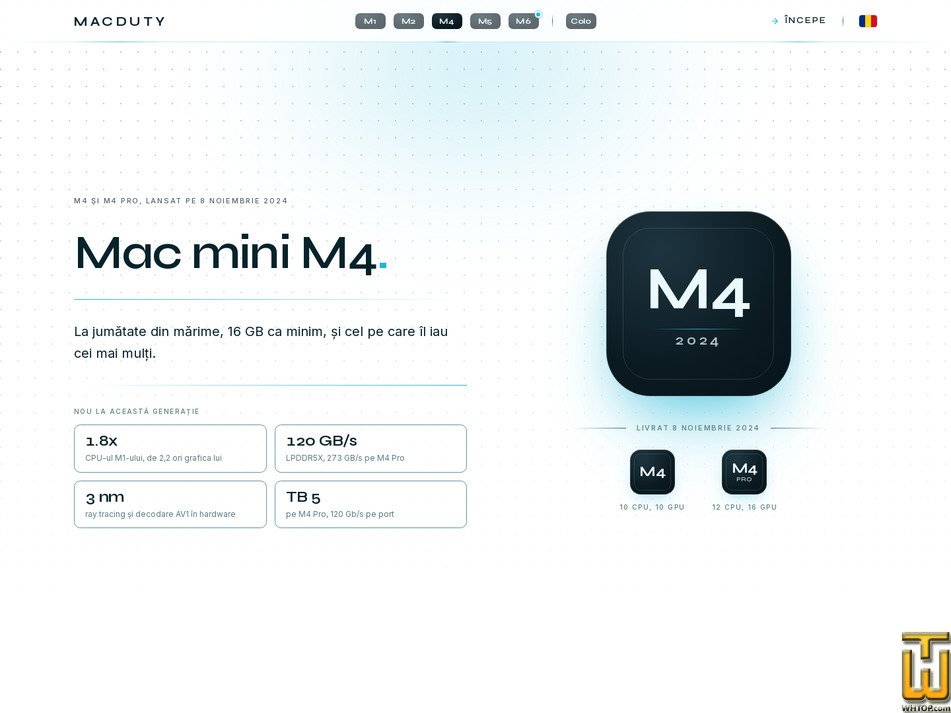
See also initial Mac mini M4 Pro 64 GB / 2000 GB SSD plan location on their website!
*📜 Plan description
Mac mini M4 Pro, model year 2024: 64 GB unified memory, Apple M4 Pro processor with 14 CPU cores and 20 GPU cores, and 2000 GB of internal SSD storage. Unified-memory bandwidth is 273 GB/s. The selected configuration costs 244.00 EUR per month before VAT. An annual prepaid term reduces the effective monthly rate by 20 percent to 195.20 EUR, for 2342.40 EUR per year; daily rental is 9.76 EUR with a 24-hour minimum. The selected SSD size is the priced configuration and the catalog also offers 512 GB, 1 TB, 2 TB, 4 TB, 8 TB internal SSD selections; higher-capacity SSD choices may change the price. No installation fee applies. Provisioning status: offered as a listed 2 TB M4 Pro 64 GB configuration. The model supports macOS from 15.1 Sequoia onward, subject to chip compatibility. The high-memory M4 Pro tier has fourteen CPU cores and twenty GPU cores, rather than the twelve CPU and sixteen GPU cores of the lower Pro tiers. The 2 TB SSD is the priced configuration; the catalog also offers smaller 512 GB and 1 TB SSD selections, with pricing that changes according to storage capacity. Memory bandwidth is 273 GB/s, with Thunderbolt 5, a 16-core Neural Engine and AV1 decoding.
One customer receives the entire physical Apple Mac mini with no shared host or intervening hypervisor. A fresh compatible macOS installation is provided; SSH login and macOS Screen Sharing or VNC remote desktop are available, with RustDesk also described as a remote-access option. The customer has administrative access and can restart the machine, reset the password, change SSH keys and reinstall macOS through the account dashboard. Each rented Mac has a dedicated gigabit network connection with one public IPv4 address and IPv6 allocation, with traffic unmetered under a fair-use policy. The hardware and stored data remain in Romania in the European Union, with GDPR data-processing arrangements available on request. Hardware failure is handled by replacement with an equivalent Mac; data on failed hardware cannot be recovered. Snapshots and managed backups are not included, so off-machine backup is the customer responsibility. The service has a 99.9 percent monthly availability target excluding specified events, with a pro-rata service credit on eligible claims. Card and SEPA transfer payment are displayed; prices exclude any applicable VAT. Consumer customers have a statutory 14-day withdrawal right subject to charges for service already provided; this is not an unconditional money-back trial.
One customer receives the entire physical Apple Mac mini with no shared host or intervening hypervisor. A fresh compatible macOS installation is provided; SSH login and macOS Screen Sharing or VNC remote desktop are available, with RustDesk also described as a remote-access option. The customer has administrative access and can restart the machine, reset the password, change SSH keys and reinstall macOS through the account dashboard. Each rented Mac has a dedicated gigabit network connection with one public IPv4 address and IPv6 allocation, with traffic unmetered under a fair-use policy. The hardware and stored data remain in Romania in the European Union, with GDPR data-processing arrangements available on request. Hardware failure is handled by replacement with an equivalent Mac; data on failed hardware cannot be recovered. Snapshots and managed backups are not included, so off-machine backup is the customer responsibility. The service has a 99.9 percent monthly availability target excluding specified events, with a pro-rata service credit on eligible claims. Card and SEPA transfer payment are displayed; prices exclude any applicable VAT. Consumer customers have a statutory 14-day withdrawal right subject to charges for service already provided; this is not an unconditional money-back trial.
📄 Editorial Review
MacDuty is a specialized European hosting provider delivering dedicated Apple Mac mini servers and hardware colocation services from Romania. Unlike traditional web hosting companies that concentrate on shared hosting, Linux VPS, or general-purpose dedicated servers, MacDuty focuses on physical Apple silicon computers running macOS. Its infrastructure is particularly suitable for software developers, iOS and macOS development teams, continuous integration pipelines, AI automation projects, and businesses requiring permanently accessible Mac environments.The service is operated by AITEST S.R.L., a privately held Romanian company established on October 29, 2024, with its registered office in Năvodari, Constanța County. Nicolae-Bogdan Călin is the company's registered administrator and is also associated with its network administration. MacDuty maintains a relatively small, specialized organization, with a reported workforce range of 1–10 people. Its Romanian registration places the business under European Union jurisdiction, which is particularly relevant for organizations handling personal information and requiring GDPR-compliant contractual arrangements.
MacDuty's main service is Dedicated Mac mini Hosting, giving each customer exclusive access to an entire physical Apple computer. The machines are not divided between multiple customers through shared virtualization. Every rental includes macOS, administrative privileges, SSH connectivity, remote graphical desktop access, and public IPv4 and IPv6 networking. Customers can use these systems much like locally owned Macs, while MacDuty handles electricity, cooling, hardware maintenance, physical installation, and network connectivity.
The hardware selection extends across five Apple silicon generations, from the original M1 introduced in 2020 to the newer M5 Pro and M6 configurations introduced in 2026. The range includes 19 principal hardware builds, with additional SSD storage options. Customers can select configurations based on processor generation, unified memory, GPU capabilities, storage capacity, and intended applications. This flexibility makes the service suitable for everything from basic automated testing to demanding development and AI workloads.
The Mac mini M1 remains the most economical option, particularly for lightweight development, automated testing, remote desktop sessions, and continuous integration runners. Configurations feature an eight-core CPU, 8 GB or 16 GB of unified memory, and SSD capacities ranging from 256 GB to 2 TB. Despite being an older generation, the M1 remains capable of running many native Apple silicon applications, making it an attractive entry point for customers who need macOS infrastructure without investing in newer hardware.
The Mac mini M2 and M2 Pro family offers additional processing power and greater memory flexibility. Standard M2 systems provide 8 GB to 24 GB of unified memory, while M2 Pro configurations support up to 32 GB. Memory bandwidth reaches 100 GB/s on standard M2 processors and 200 GB/s on M2 Pro models. Hardware acceleration for ProRes processing also makes these computers useful for media-related applications. Storage options extend to 8 TB on selected Pro configurations, accommodating larger development environments and local datasets.
A particularly balanced choice is the Mac mini M4 and M4 Pro range. Standard M4 configurations are available with 16 GB, 24 GB, or 32 GB of unified memory, while M4 Pro systems support up to 64 GB. The Pro configurations add more CPU and GPU cores, faster unified memory, and Thunderbolt 5 connectivity. These machines are well suited to Xcode compilation, simultaneous development processes, image processing, application testing, and local AI experimentation. For many development teams, the M4 family provides an effective compromise between performance and recurring hosting costs.
The newer Mac mini M5 Pro configurations extend the available performance range further, offering 24 GB, 48 GB, or 64 GB of unified memory, with up to 18 CPU cores and 20 GPU cores. Memory bandwidth reaches 307 GB/s, making these systems particularly interesting for demanding compilation, graphics processing, and machine-learning applications that benefit from Apple's unified memory architecture. SSD storage ranges from 512 GB to 8 TB, depending on the selected configuration.
The Mac mini M6 family includes systems with 16 GB, 24 GB, or 32 GB of unified memory and a 12-core CPU. Its newer 2 nm architecture, memory bandwidth of up to 170 GB/s, and integrated neural-processing capabilities make it another option for modern development and AI workloads. Certain newer configurations have retained preorder labeling despite an indicated arrival date of October 9, 2026, so customers planning time-sensitive projects should confirm actual hardware availability before committing to a particular configuration.
Beyond equipment rental, MacDuty provides Mac mini Colocation, an interesting alternative for businesses and individuals who already own compatible Apple hardware. Customers ship their Mac mini to the company's Romanian facility, where it is professionally installed, connected to the network, and operated continuously. The customer retains ownership of the computer, while MacDuty handles the physical environment and essential connectivity.
Colocation supports Apple silicon Mac minis from the M1 generation onward, excluding older Intel-based models. The service includes rack mounting, cabling, unmetered electrical power, a dedicated network connection, public IPv4 and IPv6 addressing, and 10 TB of monthly traffic. Reverse DNS configuration is available on request. Basic remote-hands assistance covers activities such as checking cables, power cycling, and connecting a display for troubleshooting. Internal hardware repairs and component replacements remain the responsibility of the equipment owner.
Another distinctive offering is Mac Automation and Custom Provisioning. MacDuty can prepare dedicated computers with specific Xcode versions, command-line development tools, SSH keys, application certificates, development accounts, and automated build-runner software. Custom provisioning hooks, reinstallation triggers, status endpoints, and fleet-management procedures can also be arranged. These capabilities are particularly useful for organizations operating several Mac development environments that need consistent configurations and repeatable deployment procedures.
MacDuty also accommodates Mac mini Clusters, combining two to eight M4 or M6 machines through Thunderbolt 4 interconnections. These clusters are intended for distributed AI inference, parallel compilation, rendering, and other workloads that can be divided between multiple computers. Depending on the arrangement, aggregate unified memory capacities can reach 64 GB with two nodes, 128 GB with four nodes, and 256 GB with eight nodes. The service includes interconnecting cables, private networking, and application-specific configuration. Cluster deployments are customized individually rather than restricted to standardized online packages.
AI Agent Hosting represents an additional specialized use case. Dedicated Mac hardware can run continuously available AI agents, local language models, automation software, scheduled processes, and persistent application sessions. This is useful for customers who want AI-powered applications to operate around the clock without relying on a personal computer remaining switched on. Other compatible workloads include GitHub Actions, GitLab and Jenkins runners, Xcode, Final Cut Pro, Logic Pro, and macOS applications that benefit from dedicated physical resources.
Practical business implementations include PerfectApps, which uses AI-driven quality assurance workflows, and FIAR360, which integrates accounting operations with a WhatsApp-based AI assistant. Such applications demonstrate that permanently available Apple hardware can support business automation beyond conventional iOS development and software compilation.
The website is available in English and Romanian, making MacDuty accessible to both international and Romanian customers. Services can be priced in EUR and USD. Its modern, responsive interface makes it relatively easy to compare processors, memory capacities, storage options, and subscription periods. Technical guides cover topics such as remote macOS access, Xcode workflows, AI models, colocation, and cluster deployment. The knowledge base continued receiving updates in October 2026, reflecting ongoing development of the company's technical resources.
Overall, MacDuty occupies a specialized segment of the hosting market. Its main attraction is not conventional website hosting, but providing direct access to real Apple hardware in a managed physical environment. Customers receive the flexibility of a dedicated Mac, combined with predictable rental expenses and assistance with hardware provisioning, networking, and development infrastructure.