Amazon EC2 On-Demand Capacity [...], $ (on request) on Cloud
Amazon EC2 On-Demand Capacity Reservations has been updated on (added ), Aggregate Rating (10 out of 10 from 1 reviews)

410 Terry Ave N
Seattle , WA 98109-5210 US
☎ Phone (206) 266-1000
📧 info-aws@a...| 🔌 Hosted domains : | 1 |
|---|---|
| 🆓 free domains : | 0 |
| 📌 Dedicated IPs : | 0 |
| 💳 Payment Methods : | Credit / Debit / Prepaid Cards |
| 🔨 Control Panel : | [In-house] |
| ⚑ Targeting : | US |
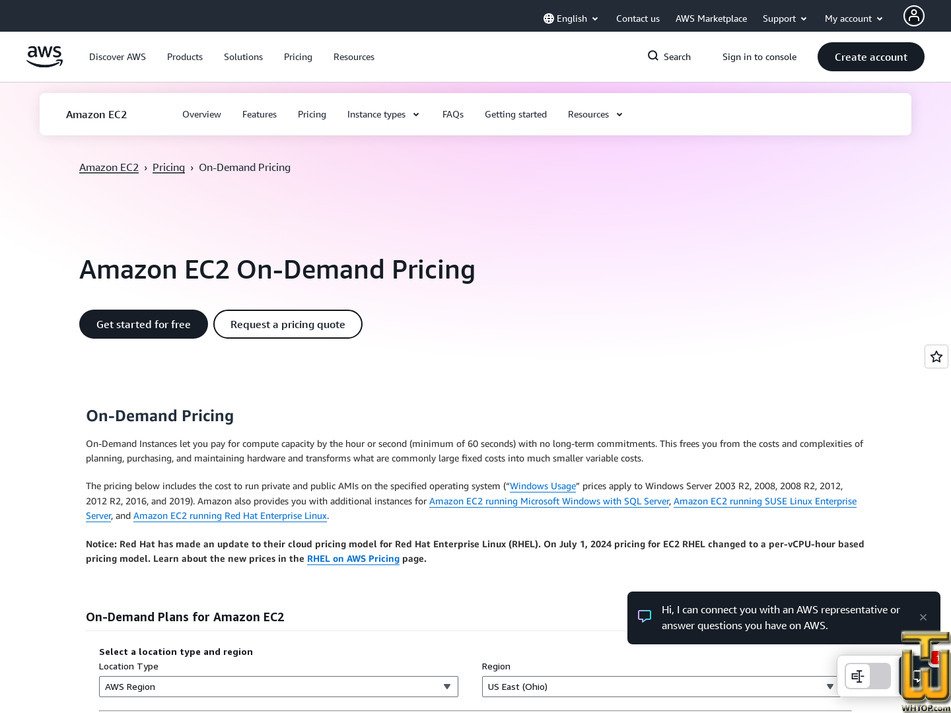
See also initial Amazon EC2 On-Demand Capacity Reservations plan location on their website!
*📜 Plan description
On-Demand Capacity Reservations reserve compute capacity in a specific Availability Zone while keeping the same On-Demand pricing as equivalent instance usage. When the reservation is fully utilized, billing is just the instance usage at On-Demand rates; when it is partially utilized, billing includes both the used portion and the unused reserved portion. This model is typically used to reduce capacity risk for steady workloads without moving to long-term commitments, while still allowing the instance lifecycle to be controlled through the normal EC2 launch and stop workflow.
Operational notes:
- The reservation itself does not discount pricing; it matches On-Demand.
- Underutilization results in charges for unused reserved capacity.
- Best suited for workloads that must run in a specific zone and need predictable capacity.
Amazon EC2 is operated through AWS's self-service console and APIs, so capacity can be launched, stopped, and scaled without owning hardware. Pricing is usage-based and varies by AWS Region, while taxes and duties may apply depending on billing address and local rules.
Operational notes:
- The reservation itself does not discount pricing; it matches On-Demand.
- Underutilization results in charges for unused reserved capacity.
- Best suited for workloads that must run in a specific zone and need predictable capacity.
Amazon EC2 is operated through AWS's self-service console and APIs, so capacity can be launched, stopped, and scaled without owning hardware. Pricing is usage-based and varies by AWS Region, while taxes and duties may apply depending on billing address and local rules.
📄 Editorial Review
Amazon Web Services (AWS) is the cloud-computing division of Amazon, active since 2006 and grown into one of the largest infrastructure providers worldwide. Instead of a traditional web host with a handful of shared plans, AWS offers a very broad catalogue of infrastructure, platforms and managed services that can run everything from a small website to a global enterprise application.They operate their own infrastructure, organized into Regions around the world, each split into multiple Availability Zones (AZs). Every Region contains several AZs with independent power, cooling and connectivity, designed so that if one AZ fails, workloads spread across multiple zones can keep running. There are Regions across North and South America, Europe, the Middle East, Africa, and Asia-Pacific, so customers can choose locations close to their users or within specific legal jurisdictions.
From a hosting customer’s point of view, the main product families are:
- Cloud servers / VPS and "virtual dedicated"
- Amazon EC2 is the core compute service: virtual machines in many families (general purpose, compute-optimized, memory-optimized, storage-heavy, GPU, ARM, and even bare-metal options). You choose the operating system (various Linux distributions or Windows Server), storage type and network performance profile.
- Amazon Lightsail is the simplified option aimed at smaller projects. It bundles virtual private servers, managed databases, containers, DNS and load balancers with fixed monthly pricing and a much easier console, including ready-made blueprints for WordPress, LAMP/LEMP and other application stacks. For someone used to a classic VPS, Lightsail feels the most familiar entry point.
- For strict licensing or compliance needs, Dedicated Hosts and Dedicated Instances give you physical server capacity reserved to a single customer.
- Storage and databases
- Amazon S3 provides highly durable object storage and can directly host static websites (HTML, CSS, JavaScript) at very low cost, which is ideal for brochure sites or single-page apps.
- EBS and EFS cover block-level and network file storage for EC2, suitable for databases and shared application storage.
- Amazon RDS and Amazon Aurora deliver managed databases (MySQL, PostgreSQL, MariaDB, SQL Server, Oracle and AWS’s own Aurora engines). Backups, software updates, failover and many maintenance tasks are handled by AWS, which is attractive when a team wants reliable databases without managing everything by hand.
- DNS, domains, SSL, CDN and edge services
- Amazon Route 53 combines authoritative DNS, health checks, traffic-based routing and domain registration in one place, so both domains and DNS can be managed inside AWS.
- AWS Certificate Manager (ACM) issues and renews free public SSL/TLS certificates for many AWS resources such as load balancers and CloudFront distributions, removing most of the manual work that older shared hosts still require for certificates.
- Amazon CloudFront is the built-in CDN, with a large network of edge locations for caching content close to users and integrating tightly with S3, application load balancers and custom origins, plus optional web application firewall and DDoS protections.
- Email, messaging and VPN
- Amazon SES is used for transactional and bulk email sending (password reset messages, newsletters, notifications) rather than as a full mailbox hosting service.
- Amazon WorkMail provides hosted business email and calendar, with familiar protocols so users can connect using standard mail clients and mobile devices.
- For connectivity, services like AWS Site-to-Site VPN, AWS Client VPN and AWS Direct Connect give options from encrypted tunnels over the public internet up to private leased lines directly into AWS Regions.
- Application platforms and serverless
- AWS Elastic Beanstalk simplifies deploying applications in languages like Java, .NET, PHP, Node.js, Python, Ruby, Go, and Docker. It automates capacity provisioning, load balancing, autoscaling and application health monitoring.
- ECS and EKS cover container orchestration, and AWS Lambda allows serverless execution of code. These are powerful options for modern microservice architectures, though they are already a step beyond "classic hosting" and assume some DevOps knowledge.
- Security, monitoring and management
- Identity and permissions run through IAM, with AWS Organizations and single sign-on options for multi-account environments.
- Monitoring and logging rely on CloudWatch, CloudTrail and various service-level logs, giving detailed insight into performance and security events.
- Infrastructure can be defined as code using CloudFormation or the AWS CDK, and the AWS Marketplace offers ready-made virtual appliances, control panels and third-party software images that plug directly into AWS.
The website, console and documentation are multilingual. AWS supports a wide range of languages, including English, German, French, Spanish, Italian, Portuguese, Japanese, Korean, Simplified and Traditional Chinese, and several others, which is helpful for teams outside the English-speaking world.
Overall, AWS is a global cloud platform than a classic "web hosting company". This brings enormous flexibility and scale, but also more responsibility and complexity for the customer compared with a simple shared-hosting account.
📉 Similar hosting plans from other companies in the same category & country location ≡
- 💡 Plan: Custom
- 🔧 Category: Cloud
- 💻 OS Type: Linux
- 💰 Price: $ (on request)
- 💲 Setup Fee: free
- 📅 Added:
- 📆 Updated:
- 🌏 Server in:

- 💡 Plan: Enterprise Edition
- 🔧 Category: Cloud
- 💻 OS Type: Linux
- 💰 Price: $ (on request)
- 💿 Disk Space: unlimited
- 📶 Traffic bandwidth: unmetered
- 💲 Setup Fee: free
- 📅 Added:
- 🌏 Server in:

- Media Fire
 🏆 Alexa Rating98 ▼👤 User Rating 👉 Total Reviews: 21
🙌 Average Rating: 5.3 / 10
👍 Good Reviews: 11
👎 Bad Reviews: 10
👈 Official Responses: 0- 💡 Plan: Basic
- 🔧 Category: Cloud
- 💻 OS Type: Linux
- 💰 Price: $ 0.00/mo.
- 💿 Disk Space: 10 GB
- 📶 Traffic bandwidth: unmetered
- 💲 Setup Fee: free
- 📅 Added:
- 📆 Updated:
- 🌏 Server in:
- Aggregate Rating (1 out of 10 from 1 reviews)

- IDrive
 🏆 Alexa Rating21,665 ▼👤 User Rating 👉 Total Reviews: 1
🙌 Average Rating: 10 / 10
👍 Good Reviews: 1
👎 Bad Reviews: 0
👈 Official Responses: 0- 💡 Plan: IDrive Basic
- 🔧 Category: Cloud
- 💻 OS Type: Linux
- 💰 Price: $ 0.00/mo.
- 💿 Disk Space: 10 GB
- 📶 Traffic bandwidth: unmetered
- 💲 Setup Fee: free
- 📅 Added:
- 📆 Updated:
- Aggregate Rating (10 out of 10 from 1 reviews)


