hstq.net Dual Xeon Silver 4208 + RTX [...], $ 611.00/mo.
Dual Xeon Silver 4208 + RTX 2080 Ti has been added on Oct 26, 2026

| 💪 CPU/Cores : | 2 × Intel Xeon Silver 4208 16C/32T total |
|---|---|
| 🔋 RAM : | 256000 MB |
| 🔌 Hosted domains : | unlimited |
| 🆓 free domains : | 0 |
| 📌 Dedicated IPs : | 1 |
| 💳 Payment Methods : | Credit / Debit / Prepaid CardsWire TransferBitcoin |
| 🔧 Category : | Self Managed |
| ✍️ Support Options : | EmailHelp DeskPhone / Toll-FreeAvailable 24/7 |
| 🌏 Server Locations : | Netherlands |
| 🚀 Uptime : | 99.99 % |
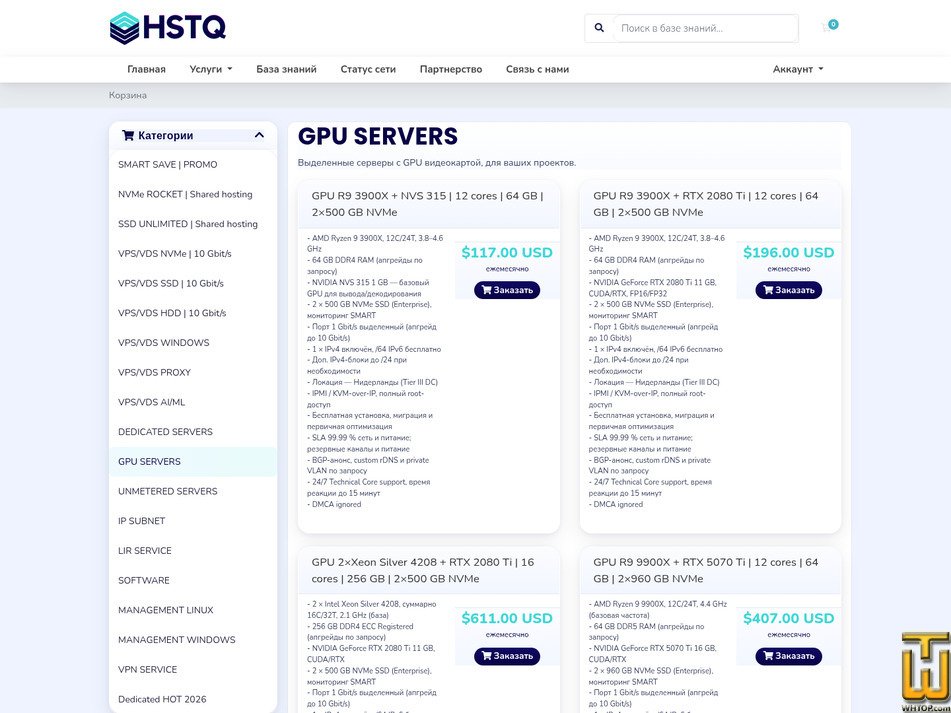
See also initial Dual Xeon Silver 4208 + RTX 2080 Ti plan location on their website!
*📜 Plan description
GPU bare-metal server equipped with 2 × Intel Xeon Silver 4208 16C/32T total, 256 GB RAM, GeForce RTX 2080 Ti 11 GB CUDA-capable GPU, and 1000 GB total enterprise NVMe SSD storage. Storage is supplied as two drives, and the network connection is listed as 1 Gbit/s with an optional network upgrade.
These are physical GPU servers hosted in the Netherlands with root access and IPMI/KVM remote hardware control. Enterprise NVMe storage, optional memory or network upgrades and a separate 1 Gbit/s port are listed. Default plans include one IPv4 and a free IPv6 /64. Hardware/network assistance and setup/migration support are available; the network/power SLA is advertised as 99.99% in the billing category. GPU memory, graphics compatibility and vendor driver requirements should be matched to the intended render/AI workload. A display-only NVS GPU is not suitable for contemporary CUDA-based ML training. Applications, licences and specialized GPU stack installation are not included in the standard hardware rental and require separate arrangements.
These are physical GPU servers hosted in the Netherlands with root access and IPMI/KVM remote hardware control. Enterprise NVMe storage, optional memory or network upgrades and a separate 1 Gbit/s port are listed. Default plans include one IPv4 and a free IPv6 /64. Hardware/network assistance and setup/migration support are available; the network/power SLA is advertised as 99.99% in the billing category. GPU memory, graphics compatibility and vendor driver requirements should be matched to the intended render/AI workload. A display-only NVS GPU is not suitable for contemporary CUDA-based ML training. Applications, licences and specialized GPU stack installation are not included in the standard hardware rental and require separate arrangements.
📄 Editorial Review
HSTQ is an international web hosting and infrastructure provider operating under the legal entity BVI HSTQ Hosting quality service, registration number 6949321. The company maintains its registered address in Road Town, Tortola, British Virgin Islands, and serves customers across Europe, North America, and Asia. Its portfolio combines affordable website hosting with virtual servers, dedicated hardware, GPU computing, high-bandwidth infrastructure, IP address leasing, network resource management, and professional server administration.HSTQ accommodates individual website owners, developers, online businesses, SaaS operators, and organizations with more specialized infrastructure requirements. One of its strongest characteristics is the combination of conventional web hosting with advanced networking services, including IPv4 subnet rental, BGP routing, ASN assistance, and LIR-related operations. Customers can start with an inexpensive hosting package, upgrade to a VPS, and eventually move to dedicated equipment or customized network infrastructure.
The company operates in Russian and English, with its primary Russian-language website complemented by an international English-language version. Both interfaces support hosting orders, account management, and access to technical services. Pricing is primarily in US dollars (USD). The websites have a modern, responsive design, with convenient navigation, product configuration options, and direct access to the customer billing portal.
Shared Hosting is available in SSD and NVMe configurations, organized into eight plans across two product families. The SSD range includes SSD Seed, SSD Grow, SSD Scale, and SSD Peak, while the NVMe family consists of NVMe Nano, NVMe Start, NVMe Pro, and NVMe Ultra. These packages accommodate personal websites, blogs, business applications, WordPress installations, and online stores.
The NVMe packages start with 5 GB of storage and scale to 60 GB, while SSD plans offer larger allocations ranging from 150 GB to 750 GB, subject to applicable usage policies. Computing resources vary by package, with entry-level configurations including 1 vCPU and 512 MB RAM, while higher plans provide up to 2 vCPU and 2 GB RAM. Certain packages support an unlimited number of websites, although CPU, memory, storage, and other resource restrictions remain applicable.
Shared hosting includes Plesk, PHP 8.x, SSL support, automatic CMS installation, email management, and automated account backups. Legacy PHP versions from 5.6 through 7.4 remain available for older applications. WordPress and other popular content management systems can be installed through the hosting interface, and basic website migration assistance is available when arranged in advance. Customers can select hosting locations in the Netherlands, Germany, United Kingdom, United States, Singapore, and Russia.
VPS/VDS Hosting is another major part of HSTQ's infrastructure portfolio. Its virtual servers include NVMe, SSD, and storage-oriented configurations, providing choices between high disk performance, larger memory allocations, and economical bulk storage. Standard NVMe configurations range from 2 vCPU, 2 GB RAM, and 40 GB storage to 12 vCPU, 24 GB RAM, and 320 GB storage. SSD-based VPS packages reach 48 GB RAM and 640 GB storage, while storage-oriented HDD configurations provide capacities up to 10 TB.
Virtual servers include root access, operating system installation options, custom ISO support, and network connections with 10 Gbit/s ports. This represents the physical or virtual port capacity rather than guaranteed continuous throughput. Actual performance depends on network utilization, location, routing, and traffic policies.
Standard VPS provisioning is automated, with most configurations becoming available within 1–2 minutes after payment confirmation. Manual verification, custom installations, and special networking requirements may increase activation times. Customers can upgrade their resources when their applications require additional processing power, memory, or storage.
HSTQ also provides several specialized VPS categories. Windows VPS supports remote desktop environments, Windows-based applications, .NET workloads, and Microsoft SQL Server deployments. Commercial software licenses, including Windows Server, RDS CALs, and database licenses, are not automatically included and may require separate arrangements.
AI/ML VPS targets CPU-based machine learning inference, embeddings, retrieval-augmented generation applications, APIs, and development environments. These servers are practical for lightweight AI workloads, although computationally demanding model training generally requires dedicated GPU hardware.
Telegram Bot VPS accommodates bots, webhooks, messaging integrations, background workers, and automation applications. Proxy VPS supports legitimate proxy infrastructure, network services, and traffic management. Customers can deploy Docker and other application environments, with software configuration and ongoing administration remaining their responsibility unless managed services are purchased.
Dedicated Servers provide exclusive access to physical hardware for demanding websites, large databases, virtualization platforms, enterprise applications, and storage-intensive workloads. HSTQ offers Intel Xeon, AMD Ryzen, and AMD EPYC processors, together with NVMe SSD, conventional SSD, and high-capacity HDD storage.
Entry-level dedicated machines include older Xeon processors suitable for economical hosting and general business workloads. More powerful AMD Ryzen and EPYC configurations offer substantial processing capabilities, larger memory allocations, and faster storage for virtualization, databases, and computational applications. Hardware configurations vary by location and can include remote IPMI/KVM access, additional drives, networking upgrades, and customized resource allocations.
Dedicated servers are available in France, the Netherlands, Germany, Poland, Estonia, and Singapore, with additional regional options across the wider infrastructure portfolio. Network ports range from 1 Gbit/s to 3, 5, 10, 25, and 40 Gbit/s on selected configurations. Standard in-stock dedicated servers are normally provisioned within 2–12 hours.
GPU Dedicated Servers extend the portfolio to AI inference, machine learning, rendering, virtual desktop environments, and other graphics-accelerated applications. Available systems include NVIDIA NVS 315, RTX 2080 Ti, and RTX 5070 Ti hardware.
The NVIDIA NVS 315 is primarily suited to basic graphics and virtual desktop tasks rather than modern CUDA-based machine learning. RTX-equipped systems are more appropriate for GPU computing, rendering, and AI applications. Customers should select GPU hardware according to its supported frameworks, video memory, and computational capabilities rather than relying solely on the presence of a graphics card.
High-Bandwidth and Unmetered Servers accommodate streaming platforms, CDN applications, file distribution, large storage services, and other network-intensive workloads. HSTQ offers configurations with 10 Gbit/s connectivity through to specialized systems featuring 100 Gbit/s ports, up to 128 CPU cores, and as much as 1 TB RAM.
Traffic allowances differ substantially between these products. Some high-bandwidth packages include 330 TB or 3,300 TB of monthly outbound traffic, with unrestricted inbound traffic under their respective conditions. Other configurations provide unmetered transfers within specific network policies. Port speed, guaranteed throughput, and included traffic are separate characteristics, making the exact bandwidth agreement important for high-volume applications.
Domain Registration covers more than 500 domain extensions, including .com, .net, .org, .online, .io, and .dev. Customers can register, renew, and transfer domain names while managing DNS records and domain portfolios from their accounts. Domain services integrate with the company's hosting, email, and SSL functionality.
VPN Services provide encrypted network connections using VLESS and Shadowsocks protocols. Compatible clients include v2rayN, v2rayNG, Shadowrocket, and Clash, with support for Windows, macOS, Linux, Android, and iOS. The standard VPN subscription operates on monthly billing without a separate fixed traffic quota, although speeds and service availability remain subject to network conditions and acceptable-use restrictions.
IPv4 Address Rental is one of HSTQ's more specialized services. Customers can rent address blocks ranging from /27 to /22 for hosting infrastructure, virtualization, network applications, and other legitimate business requirements. Available options depend on subnet size and include reverse DNS, WHOIS modifications, Letters of Authorization, BGP announcements, and GRE routing arrangements.
Larger subnets provide greater flexibility for independent routing and network integration. Smaller blocks, particularly those below /24, have more restrictive routing and documentation possibilities. Customers operating their own networks should establish the intended announcement and routing configuration before ordering IP resources.
LIR and ASN Services support organizations that require autonomous system numbers, IP address resources, and registry administration. HSTQ assists with ASN registration, IPv6 resources, WHOIS information, reverse DNS, IRR objects, RPKI coordination, and address-space transfers. These services are especially useful for network operators, infrastructure companies, and businesses expanding into independent IP routing.
Managed Server Administration is available for Linux and Windows environments. It covers monitoring, software updates, security hardening, firewall configuration, performance optimization, incident response, backup management, and infrastructure maintenance. Economy, Standard, and Premium packages provide different monthly engineering-hour allowances and response-time targets, making professional administration accessible without employing a full-time internal systems team.
The company also maintains technical utilities for WHOIS/RDAP queries, DNS diagnostics, SSL/TLS checks, email authentication, GeoIP information, DNSBL verification, and ASN/BGP prefix lookups. Downloadable Linux and Windows backup scripts offer additional convenience for administrators, although these templates require adaptation and testing before production deployment.